
Access Orange County Warrant Records
Orange County warrant records are kept by the Sheriff's Office and the Circuit Court Clerk in Orange. The Sheriff serves and stores active warrants across this Piedmont county between Charlottesville and Fredericksburg. The court clerk holds the case file once a warrant is returned. You can look up Orange County warrant records by name through the state online case search, by phone with the Sheriff's records desk, or in person at the courthouse. This page walks through where to look, what each office holds, and how to ask for a copy of a warrant file in Orange County.
Orange County Warrant Records Overview
Where to Find Orange County Warrant Records
Three offices share the load on Orange County warrant records. The Sheriff's Office runs the active side. Deputies serve fresh warrants, hold paper files for unserved orders, and field calls about open cases. The Circuit Court Clerk keeps the felony case files and the warrants tied to indictments and capias orders. The General District Court Clerk holds the misdemeanor and traffic warrant case files. All three sit at or near the courthouse complex in Orange.
For most public users, the fastest start is the state case search. The Virginia Judicial System hosts a free name search at eapps.courts.state.va.us/gdcourts/ that covers Orange General District Court. Felony files for the county show up in the circuit court case search. Both tools are free. Both run around the clock. Search by last name, first name, hearing date, or case number.
The Sheriff's records desk is the right stop for active warrant questions. Call ahead. Some warrant data is held back to keep the search fair. A clerk can confirm whether a warrant is on file, but the full text of the affidavit may stay sealed until the warrant has been served and returned to the court under Va. Code § 19.2-57.
Note: Orange County is part of the 16th Judicial Circuit, so some files may flow through neighboring court offices in the same circuit.
Orange County Sheriff and Warrant Service
The Orange County Sheriff's Office is the lead agency for warrant service in the county. Deputies cover the entire county and run patrol from the courthouse base in Orange. The Sheriff also runs the county jail or holds people picked up on local and out-of-county warrants until they can be moved. If you need to ask about an active warrant, the records unit is the right place to call. Walk-ins are usually welcome during weekday hours.
Deputies serve arrest warrants under Va. Code § 19.2-76, which gives any sworn officer in Virginia the power to serve a warrant signed anywhere in the state. After the arrest, the deputy endorses the warrant with the date and time, then returns it to a magistrate or judge with bail-setting power. That return is the moment the warrant moves from the Sheriff's active file to the court clerk's case file. Until then, public access stays limited.
You can also ask about civil process, capias orders for failure to appear, and bench warrants from the General District or Circuit Court. The records desk staff will share what they can. They will not give out the names of officers on active assignment or details that could tip off a suspect.
Orange Circuit Court Clerk Warrant Records
The Orange County Circuit Court Clerk in Orange holds the felony case files. Once the grand jury returns an indictment or a magistrate signs a capias, that paper lives with the clerk. Warrant returns, bond paperwork, and court orders are all part of the file. You can ask the clerk for a paper copy or read the file at the public terminal in the clerk's office.
Orange Circuit Court is part of Virginia's 16th Judicial Circuit. Felony cases start in General District Court for a probable cause hearing, then move up to Circuit Court for trial if the case is sent forward. The Circuit Court Clerk also holds search warrants and the affidavits that back them, once the warrant has been served and returned. Search warrants in Virginia carry a 15-day clock under Va. Code § 19.2-56.
Copy fees are set by state law. The clerk may charge a small per-page fee for paper copies and a flat fee for certified copies. Most file viewing is free if you visit in person and read the file in the office.
How to Search Orange County Warrant Records Online
The state case search is the main online tool for Orange County warrant records. Go to eapps.courts.state.va.us/gdcourts/ and accept the terms. Pick General District Court. Pick Orange County from the court list. Type a last name and first name. The system will list any matching cases. Click a case to see charges, hearing dates, and case status. Cases tagged "capias" or "failure to appear" often link back to a live warrant.
For felony files, run the same kind of name search at the circuit court case search tool. Pick Orange County Circuit Court. The system will return felony case results that may include the warrant or capias that started the case. The case detail screen shows the charge, the statute, the hearing dates, and the current status. Felony warrants are issued under Va. Code § 19.2-71, which sets the probable cause standard for any arrest warrant in Virginia.
What to have ready before you search:
- Full legal name of the person
- Date of birth, if known
- Approximate case date or charge
- A case number, if any
The state portal is the official tool. It is the same database used by clerks and lawyers across Virginia. Records load on each court's own schedule, so very recent filings may not show up for a few days.
Note: The Virginia case search does not show open arrest warrants by design, but it does show capias and bench warrant entries that have been logged by the clerk.
Types of Orange County Warrant Records
Orange County uses the same warrant types as the rest of Virginia. The most common is the arrest warrant. A judge, clerk, or magistrate signs an arrest warrant under Va. Code § 19.2-71 after weighing a sworn complaint and finding probable cause. The warrant must name the person, list the charge, and tell an officer to make the arrest. Form and content rules are spelled out in Va. Code § 19.2-72.
Bench warrants are signed by a judge when a person fails to show up for a court date. Capias warrants work much the same way and often issue for probation violations or contempt of court. Search warrants give an officer the right to search a place or seize property. They are governed by Va. Code § 19.2-52 and need a sworn affidavit under Va. Code § 19.2-54.
A Orange County warrant file usually has the name of the accused, any aliases, the date of birth, the charge and statute, the issuing court, the date the warrant was signed, the bond amount, and the return of service. After the warrant is served and returned to the clerk, most of that content is open to the public under the Virginia FOIA rules in Va. Code § 2.2-3704.
Statewide Tools for Orange County Warrant Search
State databases pick up where the local search ends. The Virginia State Police runs the Central Criminal Records Exchange, which logs arrests once a warrant has been served and the person fingerprinted. You can ask for a name-based criminal history check on Form SP-167 through the Virginia State Police criminal background check page. The fee is $15 per name. The form must be notarized.
The VSP page is the official state path for Orange County warrant lookups by mail. Visit the Virginia State Police criminal background page for current forms and the mailing address.
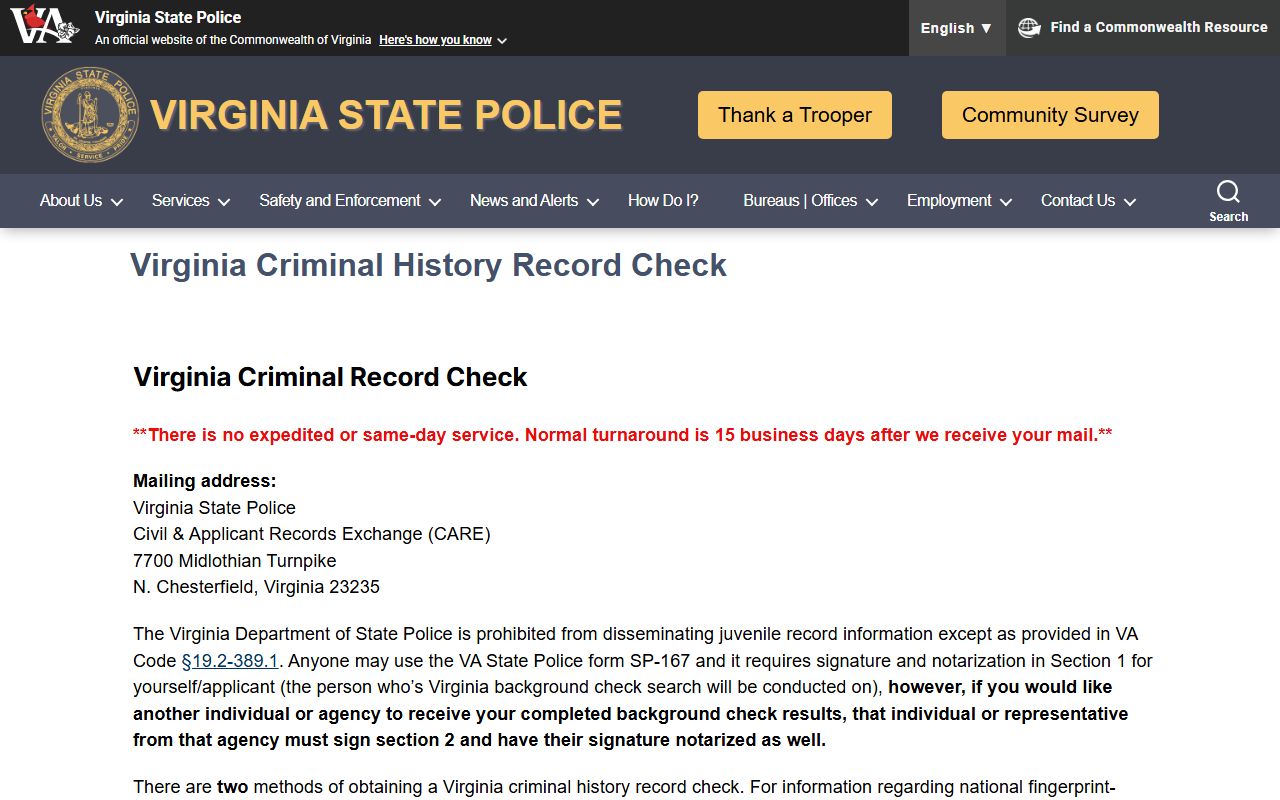
The page lays out the SP-167 process used for Orange County and statewide warrant and arrest record requests. It is the official channel for any name-based criminal history check in Virginia.
The Virginia Department of Corrections offender locator shows people in state custody. If a Orange County warrant led to a felony conviction and state prison time, the person may show up in this tool. The Virginia sex offender registry is a free public search and lists Orange County registrants. Federal warrants out of Orange run through the U.S. District Court for the Western District of Virginia.
Orange County Warrant Records and Virginia FOIA
The Virginia Freedom of Information Act, found at Va. Code § 2.2-3700 et seq., gives any person the right to ask for public records held by Virginia public bodies. That covers most Orange County warrant records once the warrant has been served and the file has been returned to the court. A FOIA request to the Sheriff or the clerk must be answered within five working days. The office may take a seven-day add-on if more time is needed.
Open criminal investigative files have a longer clock. Under Va. Code § 2.2-3706.1, a public body has up to 65 working days to answer a request for active investigative records. The agency may also withhold parts of the file that name a confidential informant or that would put a witness in danger.
You can ask for help from the Virginia FOIA Advisory Council if your request is denied or stalled. The Council gives free advisory opinions to both the public and to public bodies. Search fees can be charged for staff time and copy cost, but not for general overhead.
Public Access to Orange County Warrant Records
Most Orange County warrant records are open to the public. Once the warrant is served and the file is back with the clerk, anyone can ask for a copy. The clerk will pull the file and let you read it on the spot or make copies for a small fee. You do not have to give a reason for your request. You do not need to be a Virginia resident.
Some parts of a warrant case file may stay closed. Search warrant affidavits can be sealed by court order while a case is open. Files involving juveniles have their own privacy rules under Virginia law. Records that name a confidential informant or could put a witness in danger may be held back. Court rulings on what to seal are made case by case and depend on the facts of the file.
The full text of the Code of Virginia is online at law.lis.virginia.gov. Title 19.2 controls criminal procedure. Title 2.2 holds the FOIA rules. Both titles are the legal source for warrant access in Orange County and across Virginia.
Note: If a warrant case file is sealed, the clerk will tell you so but cannot release the content without a court order from a judge.
Nearby Counties
Orange County borders Madison, Culpeper, Spotsylvania, Louisa, Albemarle, and Greene. The 16th Judicial Circuit covers Orange, Madison, Culpeper, Greene, Albemarle, Louisa, Goochland, and Charlottesville.